

















Guide to visiting the Valley of the Temples, Sicily
Have you ever imagined wandering through an ancient Greek city, surrounded by perfectly preserved temples, almond trees in bloom and olive trees that have stood for a thousand years? It may sound like a dream, but you can experience it firsthand at the Archaeological and Landscape Park of the Valley of the Temples in Sicily. This remarkable complex, home to part of the ancient city of Akragas, holds such immense cultural significance that UNESCO declared it a World Heritage Site in 1997. In 2015, it was further honoured with the Declaration of Outstanding Universal Value (OUV).
In this guide to the Valley of the Temples, you’ll find everything you need to fully immerse yourself in the history, atmosphere and breathtaking beauty of Agrigento in Sicily.
1. History of the Valley of the Temples
Set on a plateau just inland from the sea and a short distance from Agrigento, the Valley of the Temples is renowned worldwide for its majestic Doric temples—among the most remarkable surviving expressions of ancient Greek art and culture.
Its origins trace back to the 6th century BC, when settlers from nearby Gela founded the colony of Akragas. The city flourished in the 5th century BC, becoming one of the most powerful and sophisticated Greek centres in Sicily. It was during this golden age that the temples we admire today were constructed. In 406 BC, Akragas fell to the Carthaginians and would not regain its former splendour until the Roman occupation. During the medieval period, several temples were restored or repurposed, a transformation that, in some cases, contributed to their survival. Today, as a World Heritage Site of exceptional value, the Valley benefits from ongoing, carefully coordinated efforts to protect and preserve its extraordinary legacy.
2. What to see in the Valley of the Temples
The protected area of the archaeological park spans roughly 1,300 hectares, making it one of the largest and most extraordinary archaeological sites in Europe and the Mediterranean. Within this vast landscape lies a monumental ensemble of exceptional beauty and historical significance. The park offers several walking itineraries as well as driving routes, each lasting between two and four hours.
Temple of Juno (Hera) and Temple of Concord
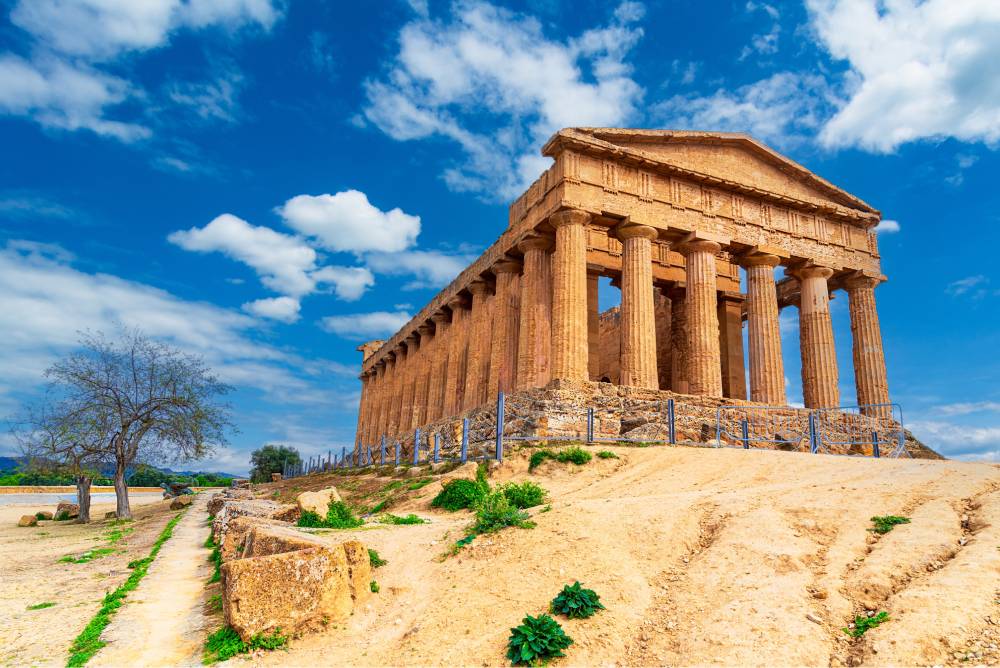
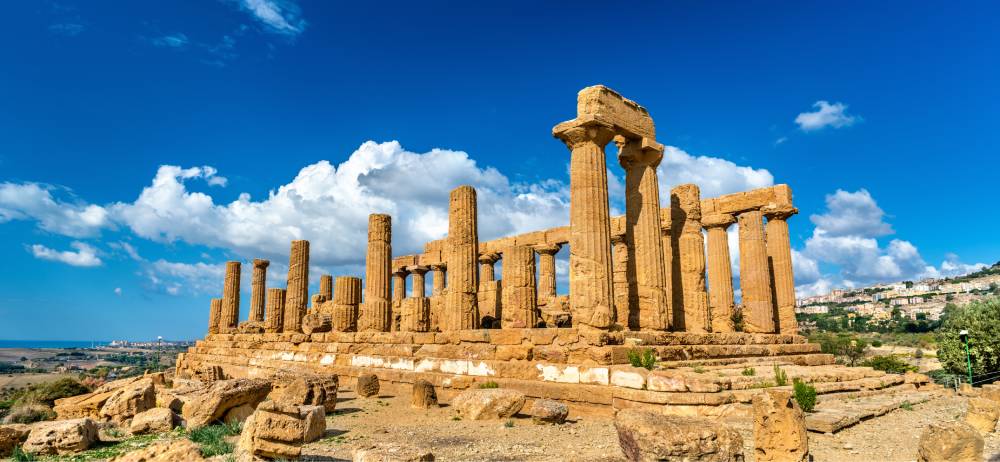
Your journey through the Valley of the Temples begins at one of its highest points, near the eastern ticket office, where the Temple of Juno rises in striking silhouette. Built around 460 BC, during the pinnacle of Doric architecture, the temple still bears visible fire marks on several column shafts—haunting traces of the Carthaginian attack.
In front of the temple lie the remains of the ancient sacrificial area, where ritual offerings were once made beneath the open sky. From here, the path follows the historic Via Sacra toward the Temple of Concord, widely regarded as one of the finest and best‑preserved masterpieces of the Doric style. As a modern counterpoint to its classical harmony, a contemporary statue of Icarus—gifted by Polish sculptor Igor Mitoraj—stands before the temple, adding a poetic dialogue between past and present.
Temple of Heracles and Temple of Zeus
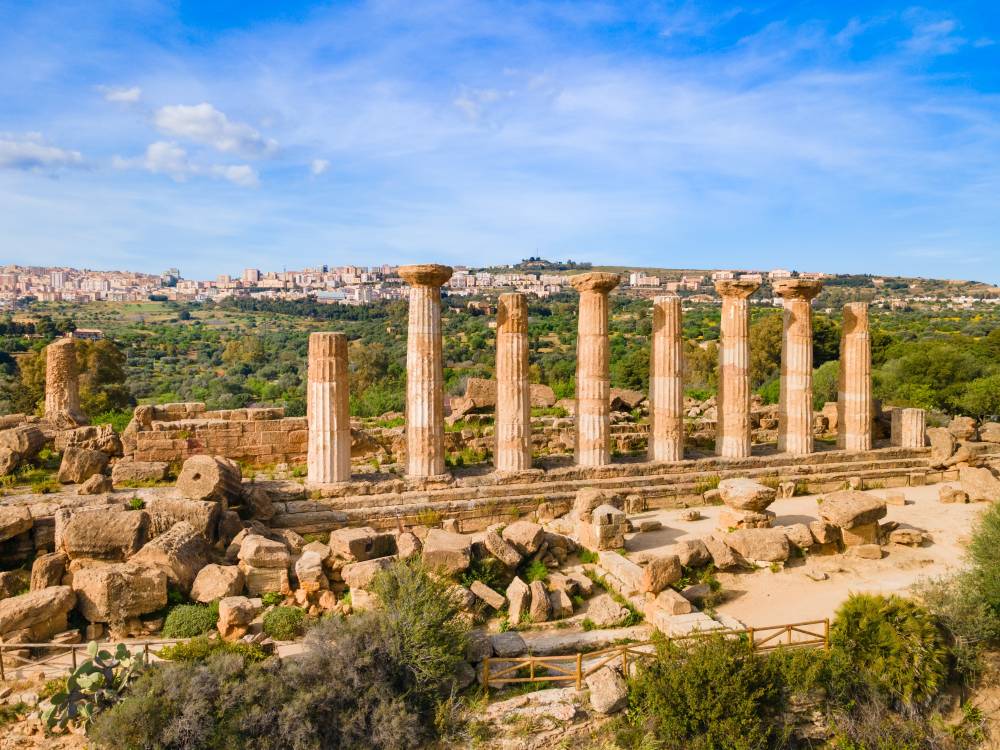
The route continues toward the heart of the monumental complex. After passing Villa Aurea, you arrive at the Temple of Heracles (Hercules), considered the oldest sanctuary in Agrigento and dating to the late 6th century BC. Its layout and surviving eight columns reflect an early stage of the Doric order, marked by sturdier proportions and a close dialogue with the surrounding landscape.
Just below the temple stands a Roman funerary monument, traditionally—though incorrectly—referred to as the Tomb of Theron. From here, entering through the Hardcastle gate, you reach one of the most awe‑inspiring areas of the Valley: the site of the Temple of Olympian Zeus (Jupiter). Envisioned after Akragas’ victory over Carthage at the Battle of Himera in 480 BC, it was once among the largest temples in the entire Greek world.
If you continue south toward Villaseta, you’ll encounter the remains of the Temple of Vulcan (Hephaestus). Only its base and two columns survive, yet they are enough to evoke the temple’s former presence atop a rocky promontory dedicated to worship.
Agrigento Regional Archaeological Museum and complementary activities
The return toward the Golden Gate offers a gentle transition from the archaeological landscape to the modern city. The path rises slowly to the hill of San Nicola, a strategic vantage point with sweeping views over the entire Valley of the Temples and the distant horizon. In antiquity, this hill was home to the upper agora of Akragas—the political and civic heart of the ancient city.
Nearby stands the Ekklesiasterion, the semicircular, rock‑cut space where the popular assembly once gathered. Overlooking this historic nucleus is the Pietro Griffo Regional Archaeological Museum, built atop the remains of a former Cistercian monastery. Its collection traces the evolution of Akragas from prehistory through the Roman era. Particularly noteworthy is its extraordinary assemblage of votive offerings—one of Sicily’s most significant—featuring black‑ and red‑figure Greek ceramics that illuminate daily life as well as religious and funerary practices.
Beyond archaeology, the Valley of the Temples offers enriching complementary experiences, such as the Barbadoro Diodoros House, where you can discover products cultivated within the park itself, or the Sensory Garden, a serene corner designed to awaken the senses through aromatic plants, textures and natural sounds.
-
What’s the best time of year to visit the Valley of the Temples?
Spring and autumn—when temperatures are gentle and the light is beautifully soft—are the ideal seasons to explore the Valley of the Temples. In summer, especially July and August, the heat can be intense and the site tends to be much busier.
-
How do you get to the Valley of the Temples?
The archaeological park sits just outside the city of Agrigento, in southern Sicily. From Palermo or Catania, the drive takes roughly two and a half hours. You can also reach Agrigento by train and continue to the site by public transport or on foot.
-
Are there guided tours of the Valley of the Temples?
Yes! The park offers official guided tours—both group and private—in several languages and with different thematic focuses depending on your interests. Your hotel reception can help you choose and book the best local providers.
- See more questions
More about Sicily


The best hotels in Sicily


4.0text.accommodation.listing.star.rating.stars
Sicily, Italy
Load more hotels